
Get your hands in the living soil that’s changing things.
Living soils power thriving ecosystems, richer biodiversity, and the invisible microbial life that grows our food.

Living soils power thriving ecosystems, richer biodiversity, and the invisible microbial life that grows our food.
We turn organic materials into powerful living compost through aerobic composting — a clean, oxygen-rich process that creates beneficial biology instead of harmful emissions.
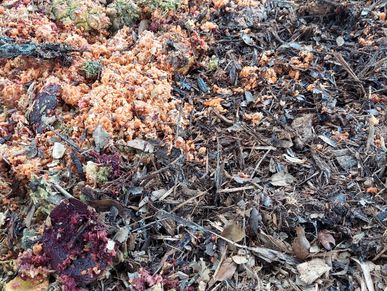
We turn what most people throw away into powerful living soil amendments.
By thoughtfully mixing green waste (nitrogen-rich) with brown waste(carbon-rich), we accelerate natural aerobic decomposition and divert tons of organic material from landfills.
This close-loop process:

We turn what most people throw away into powerful living soil amendments.
By thoughtfully mixing green waste (nitrogen-rich) with brown waste(carbon-rich), we accelerate natural aerobic decomposition and divert tons of organic material from landfills.
This close-loop process:
One sack. Two methods. Better soil, healthier plants, and a cleaner Bay.

We transform organic waste into high-quality living compost through careful aerobic composting. This process delivers real advantages:
Every batch closes the nutrient loop — creating true regenerative fertility for gardens, farms, and landscapes while supporting our waterways.

Our living compost doesn’t just add nutrients — it orchestrates a more vibrant, self-regulating soil ecosystem:
The result is deeper, more productive fertility that improves season after season — exactly what regenerative gardens, landscapes, and farms need.

We’re seeing living compost play a powerful role in ecological restoration projects around the world.
By introducing high-quality organic matter and beneficial biology, compost helps:
From urban greening projects and wetland restoration to large-scale mine site rehabilitation, strategically applied compost is helping turn barren land back into thriving, resilient ecosystems. According to the U.S. EPA, compost is increasingly recognized as a valuable tool for ecosystem conservation and restoration.
Restaurants, grocery stores, and food businesses are achieving impressive results by composting their food scraps instead of sending them to pile-up.
Real-world case studies show:
By transforming food scraps into Black Au, a living compost, businesses are closing the nutrient loop — turning potential waste into powerful regenerative fertility for gardens, farms, and ecosystems.
Living compost is transforming the way we design and care for beautiful outdoor spaces — from grand golf courses and public parks to intimate residential gardens.
Here’s how they’re making a powerful difference:
By enhancing soil structure, activating the soil food web, and improving nutrient cycling, our living compost doesn’t just feed plants — it helps create resilient, self-sustaining ecosystems that look stunning while regenerating the land beneath them.
Public parks, botanical gardens, and community green spaces are where living compost truly shine at a larger scale — helping create places where entire neighborhoods can reconnect with nature.
These shared spaces benefit in meaningful ways:
When cities and communities incorporate living compost, they’re not just maintaining green space — they’re actively regenerating small ecosystems that nourish both people and nature.
Across the country and around the world, forward-thinking municipalities and local governments are launching composting programs that turn household and business organic waste into a valuable community resource.
These programs are delivering meaningful results:
From small towns to major metropolitan areas, these municipal initiatives demonstrate strong leadership — showing how cities can close the nutrient loop, lower operating costs, and create greener, healthier communities for their residents.
Cities are increasingly integrating living compost into green infrastructure projects — smart, nature-based solutions that address urban environmental challenges head-on.
These initiatives are delivering strong results in:
By incorporating living compost into these engineered solutions, municipalities and developers are creating functional green infrastructure that works with nature instead of against it — delivering cleaner water, cooler cities, and more sustainable urban environments for the long term.
According to the U.S. EPA, compost is a proven component in green infrastructure and stormwater management practices.

We are architecting a future where schools serve as the catalysts for ecological health. Our initiative replaces passive sustainability with active regenerative practices, utilizing the campus as a site for biomass recovery and nutrient-cycle mastery. By bridging the gap between classroom theory and tangible environmental legacy, we empower students to become the architects of their own resilient future. Join us as we move beyond 'greener' thinking and into the intentional cultivation of a thriving, self-sustaining regional biome.
We utilize the science of aerobic decomposition to bridge the gap between environmental theory and tangible climate action. These intensives serve as a catalytic entry point into regional resilience, demonstrating how localized biomass management can mitigate emissions and revitalize soil vitality. Participants emerge not just informed, but equipped to drive systemic change within their own communities.
We use cookies to analyze website traffic and optimize your website experience. By accepting our use of cookies, your data will be aggregated with all other user data.